When Jev launched last month, it arrived amid the usual claims of a “fundamental new paradigm revolutionising the industry.” But one slide from founder Diogo Almeida’s AI Engineer talk1 stuck with me. It was a plain chart titled The Sane View of AI, with a line down the middle.
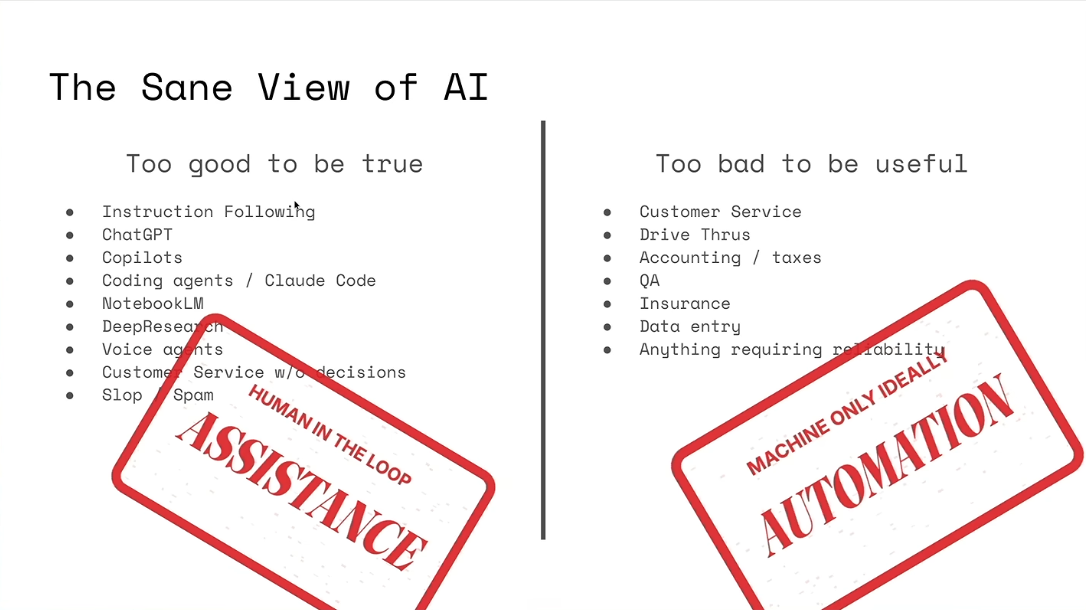
Almeida’s argument is simple. AI is astonishing at some seemingly difficult work and strangely bad at some seemingly simple work.
On one side is work such as instruction following, coding agents, copilots, and deep research. These systems can appear superhuman, but they still depend on a human in the loop. That is no accident. RLHF optimises for human preference, so these models were trained to please the human in the loop.
On the other side is work such as customer service, accounting, QA, and data entry. Nobody wants to do it, and nobody wants to watch it being done. The point of automation is to remove the human from the loop entirely. Yet this is precisely where today’s models remain unreliable.
Jev is positioned to fill the gap on the right. It gives up text generation for fast, cheap, structured decisions that software can act on directly.2 It is built as a tool for automation.
I’ve spent half a decade working on deeply technical platforms and trying to make them feel both delightful and intuitive. Almeida’s split gave me a sharper way to think about that work. As base models raise the functional floor, differentiation will move towards the extremes.
The best companies will become bimodal. To win, they have to spike at both ends of the barbell: max function and max feel. Companies that spread themselves evenly across the middle will be slowly squeezed by the rising floor of base models.
Max function
At one end are things that just work. You do not touch them. You do not know they are there. Nobody admires a payroll system, we only notice when it breaks.
Here, differentiation comes down to a brutal test. Are you cheapest, fastest, most reliable?
For two decades, Ruby on Rails creator DHH built a movement around the idea that developer joy was worth slower code. Today, he’s not so sure.3 Guillermo Rauch, CEO of Vercel, goes further. “The days of language or runtime choice based on human convenience are over. Agents are the new compilers.”4
As IDEs stop being the work destination for developers. Developer experience matters less when the developer is an agent. An agent does not care whether an API feels elegant. It cares whether the interface is predictable, legible, and hard to misuse. As agents write more of the code, the premium shifts away from what feels good to build with and towards what costs least to run.
The same applies when the agent is the customer. When an agent searches, compares, books, or buys on someone’s behalf, it values a different kind of experience. It wants structured information it can read, trust, and act on in the fewest possible steps and tokens. User experience for agents is about efficiency.
Max function is the right side of Almeida’s chart taken to its conclusion: get humans out of the loop entirely.
Max feel
At the other end is the human. Here, the goal is not efficiency. Here the goal is to please the human.
As basic functionality becomes abundant, functionality alone is harder to differentiate on. Attention becomes the scarce resource. This is why marketing is turning into vibe marketing, where the brands that win will be the ones that make people feel something before they understand anything.
The core skill is anticipation. It means knowing what someone wants before they ask and removing every moment of friction between them and that feeling. This means sweating the details of the user’s experience to an almost unreasonable degree. Every next step, every line of copy, every default.
Agents also change the product journey. In Build, Tony Fadell argues the product was never just the device.5 It was every touchpoint, from the ad to the unboxing to the support call.
Building for agents adds new touchpoints. Users must hand off tasks, grant access to tools, verify results easily, and recover when something goes wrong. Most of these happen away from any single screen. This is closer to service design than interface design because it involves shaping every encounter across people, agents, and tools so the whole experience feels effortless.
Don’t get squeezed in the middle
The middle is where products go to die. Do not build products that are not autonomous enough to ignore yet not pleasurable enough to use.
The companies that win will do both, but in different places. Make machine-facing work invisible. Make human-facing moments irresistible.
Max function for machines. Max feel for humans.
References
- 1. Diogo Almeida, “Jev CEO: I made ChatGPT, now I’m building what’s next”, AI Engineer World’s Fair 2026.
- 2. Diogo Almeida, “Introducing System One Models & Jev”, TypeSafe.
- 3. David Heinemeier Hansson, post on agents, programming languages, and performance, X.
- 4. Guillermo Rauch, “Agents are the new compilers”, X.
- 5. Tony Fadell, Build: An Unorthodox Guide to Making Things Worth Making.